Reading the Arms Trade
I expected arms spikes to track conflicts. They don't. Here's what the data actually shows — and one country where it almost does.
The hypothesis that didn't hold
When I built the anomaly detection layer for the arms tracker, the assumption felt obvious: countries import more weapons when they're fighting, or when their neighbors are. A spike in a country's Import Volume — should track conflict. That's the story arms deals seem to tell.
So I cross-referenced 497 flagged HHI anomalies against UCDP conflict data, using a geographic and temporal window: does the spiking country, or a near neighbor, have a recorded conflict within a few years of the spike?
The answer: 28% of spikes had a nearby conflict. The baseline rate — the share of country-years in the dataset that had nearby conflicts, regardless of whether there was a spike — was 27%. The anomalies predicted conflict exactly as well as chance.
What the null result means
A null result isn't a failure of the pipeline. The anomaly detection is working; the UCDP join is sound. The null result is a finding: arms trade structure is not primarily driven by active conflict. Something else is.
Looking at specific spikes, a pattern emerges. The anomalies that do align with conflict are mostly leading indicators — the spike comes before the war, not during it. Arms flows are anticipatory. Countries (or their suppliers) seem to know something is coming.
Cuba, 1960
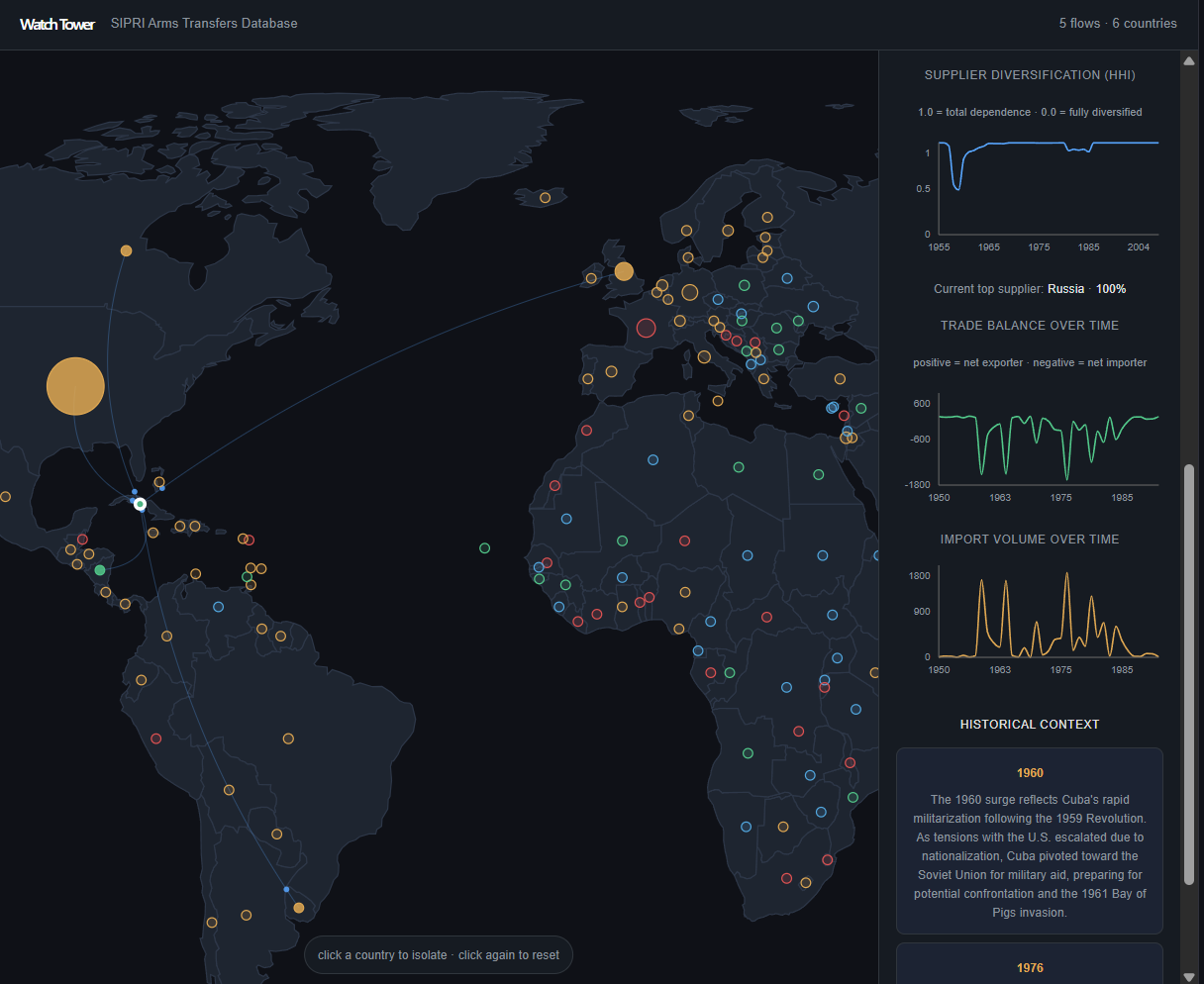
[SCREENSHOT: We can see a massive spike in Cuba's import volume in 1960.]
[HISTORICAL CONTEXT: "The 1960 surge reflects Cuba's rapid militarization
following the 1959 Revolution. As tensions with the U.S. escalated due to
nationalization, Cuba pivoted toward the Soviet Union for military aid,
preparing for potential confrontation and the 1961 Bay of Pigs invasion."]
Cuba is one of the 28% — a spike that does align with conflict. But the timing is what makes it interesting. The spike comes in 1960; the Bay of Pigs invasion doesn't happen until 1961. The weapons arrived before the war, not during it.
The chart reflects this. There's a steady baseline, then a sharp structural jump in 1960 — not the kind of gradual noise you'd expect from an ongoing conflict, but a single deliberate inflection point. The Gemini context fills in why: after the 1959 Revolution, Cuba pivoted toward the Soviet Union as U.S. tensions escalated, arming up in anticipation of confrontation.
This is what a leading indicator looks like in the data. The arms spike didn't react to the conflict — it preceded it.